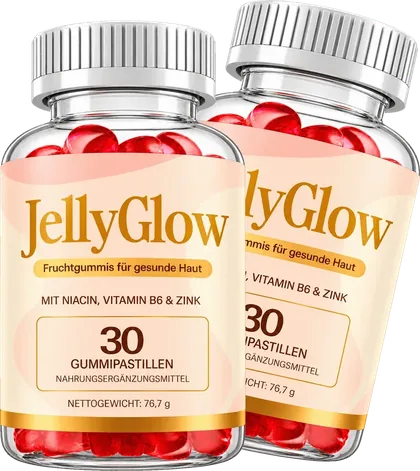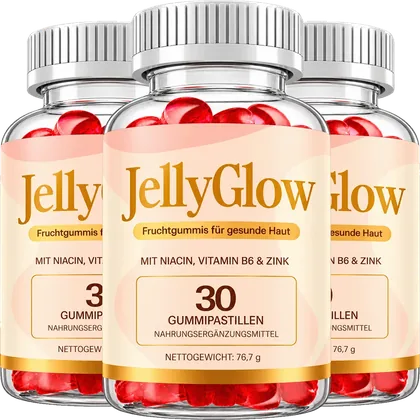
The JellyGlow Gummies benefits on the label come down to one printed line, "Gummies for Healthy Skin", which a footnote ties to niacin: "Niacin contributes to the maintenance of normal skin"1.
Those are the seller's words, not ours. This page sets out exactly what the label and seller page claim, what each nutrient is known to do in the body according to the NIH, and what the seller itself says the gummy does not promise. It also explains why a nutrient claim on a label is not the same as a promise that you will see a change in the mirror. We are an independent information site and we do not make health promises for any product.
01What benefits does the JellyGlow Gummies label claim?
The JellyGlow Gummies label makes one skin-related claim, "Gummies for Healthy Skin†", and its dagger footnote limits that claim to niacin1.
The footnote reads "Niacin contributes to the maintenance of normal skin". The front also says "WITH NIACIN, VITAMIN B6 & ZINC", which names the nutrients but makes no claim for B6 or zinc on the wrap. Nothing on the label makes a claim for maca, ginseng, rhodiola, grape seed, L-citrulline or L-carnitine.
Read carefully, the claim is narrow. "Maintenance of normal skin" describes a nutrient's everyday role in keeping normal skin normal. It does not describe changing skin, reducing lines, or adding a shine. The word "Glow" in the brand name is a name, not a claim.
02What does the JellyGlow Gummies seller page say about zinc and vitamin B6?
The JellyGlow Gummies seller page adds two more nutrient statements in German, for zinc and vitamin B6, which are standard EU-permitted wordings2.
In our translation, the seller page says:
- "Niacin contributes to the maintenance of normal skin."
- Zinc contributes to the maintenance of normal skin, hair and nails.
- Vitamin B6 contributes to the reduction of tiredness and fatigue.
These are the seller's words. In the EU, such wordings describe a general role of a nutrient and are allowed only for set nutrients at set amounts. They are not product test results. They also apply to the nutrient in general, whatever product it comes in. A box of fortified cereal or a basic multivitamin could carry the same lines. Our EU label page explains how these claim rules work.
03What do the nutrients in JellyGlow Gummies do in the body?
Niacin, vitamin B6 and zinc are essential nutrients that most adults get from food; the NIH describes their roles and sets daily amounts for each.
| Nutrient | Per gummy | Adult daily amount (NIH) | Note |
|---|---|---|---|
| Niacin | 25 mg NE | 16 mg NE men, 14 mg NE women | Helps turn food into usable fuel; upper limit 35 mg from supplements |
| Vitamin B6 | 2 mg | 1.3 mg (ages 19 to 50) | US upper limit 100 mg; EU safety body set 12 mg |
| Zinc | 1.5 mg | 11 mg men, 8 mg women | Upper limit 40 mg |
The NIH says niacin helps turn food into fuel the body can use and supports cell development and function3. Daily amounts for B6 come from the NIH B6 fact sheet4, and for zinc from the NIH zinc fact sheet5. None of these sources tested JellyGlow, so they say nothing about what the gummy will do for you. More detail is on the niacin and zinc pages.
04Do the JellyGlow Gummies plant extracts come with any benefit claim?
No. Neither the JellyGlow Gummies label nor the seller's nutrient statements make a claim for maca, ginseng, rhodiola, grape seed, L-citrulline or L-carnitine.
Health sources describe these botanicals as having limited human evidence. Maca's human research is a few small trials; rhodiola lacks reliable evidence for any health purpose; grape seed results for cholesterol and blood pressure are mixed. In this gummy, three of the extracts are present at only 1 or 2 mg, far below the amounts most studies use. That is why this site does not list them as benefits. They matter more on the safety side, because some of them interact with medicines. Our ingredients page lists each one with its main caution.
05What does the JellyGlow Gummies seller say the gummies do not do?
The JellyGlow Gummies seller page states plainly that the product does not promise a younger appearance, is not a Botox alternative and is not meant to remove wrinkles2.
Those statements matter because the name and the skin line can be read as more than they are. Botox is a prescription medical procedure given by a clinician; a fruit gummy is a food supplement you chew. The seller page also says the gummy is not a medicine and is not a substitute for a varied diet, a healthy lifestyle or medical care.
The seller page also says it shows no customer reviews or before-and-after photos because the product is new. If you see before-and-after pictures elsewhere using the JellyGlow name, they do not come from the seller page we read. Our not Botox page covers the comparison in more depth.
06Why is a JellyGlow Gummies nutrient claim not a promise of visible change?
A nutrient claim like the one on JellyGlow Gummies describes a nutrient's normal role in the body, not a result you will see on your skin.
Here is the difference in plain terms:
- Your body needs niacin, B6 and zinc to work normally.
- Most adults already get enough of these from everyday food.
- If you already get enough, adding more does not make normal skin more than normal.
- The label claim describes step 1, not a change on top of step 3.
In the US, wording like this is a structure/function claim. The FDA does not approve such claims before use, and they must carry a disclaimer that the agency has not evaluated them6. No study of JellyGlow itself was found, so there is no product-specific evidence of any visible result. Our how it works page explains the nutrient and botanical parts in more detail.
07What do the JellyGlow Gummies hair, nail and tiredness statements really mean?
The JellyGlow Gummies hair, nail and tiredness wording comes from the seller page and describes zinc and vitamin B6 in general, not the gummy's effect2.
The zinc line refers to the maintenance of normal hair and nails. The gummy holds 1.5 mg of zinc, about 14% of the US Daily Value by our arithmetic, so most of your zinc would still come from food. The B6 line refers to the reduction of tiredness and fatigue. If you feel tired often, that is worth raising with a doctor, because many causes have nothing to do with vitamins. A gummy is not a substitute for finding out why.
If you already take a hair, skin and nail product, check its zinc and B6 amounts before adding another. Totals stack, and our safety page explains which limits to watch.
08How should you judge JellyGlow Gummies benefit claims you see online?
Judge any JellyGlow Gummies benefit claim you see online against the label and the seller page; be wary of any claim that goes further than those.
Look-alike pages use the same name, and at least one uses a misspelled web address. Pages like these may describe results the seller itself does not claim. A few questions help you sort what you read:
- Does the claim match the label's niacin skin line or the seller's zinc and B6 wording, or does it go beyond them?
- Does it describe a visible change, a timeline or a percentage? The seller page we read offers none of those.
- Does it quote reviews or show before-and-after photos? The seller page says it shows neither because the product is new.
- Does it name a study of the product? We found no study of JellyGlow itself.
The FTC has a rule against fake reviews and testimonials7, and its online shopping advice suggests checking who you are buying from8. Our is it legit page walks through those checks.
09Who should talk to a doctor before trying JellyGlow Gummies?
Anyone pregnant, nursing, under 18, with a medical condition, or taking any medicine should talk to a doctor or pharmacist before trying JellyGlow Gummies1.
This includes people with diabetes, because sugar and glucose syrup lead the ingredients list, and people taking blood pressure, erectile-dysfunction or seizure medicines, because of the botanicals and amino acids. Never change or stop a medicine to make room for a supplement. If, after that conversation, you still want to try it, you can see the live price and read the terms at checkout. Our medications page lists each interaction.
Safety: JellyGlow is for adults 18 and over. The label says it is not for pregnant or nursing women. Its vitamins add up with other supplements, and it lists botanicals with limited safety data, including ginseng and L-citrulline, which can matter with medicines for blood sugar, blood pressure or erectile dysfunction. If you have a medical condition or take any medicine, ask your doctor or pharmacist before use. Never change a prescribed medicine on your own. Stop and get medical help for a severe rash, swelling, trouble breathing, fainting, or yellow skin or eyes.
Frequently asked questions
What are the JellyGlow Gummies benefits for skin, according to the label?
The label prints "Gummies for Healthy Skin" with a dagger, and the footnote reads "Niacin contributes to the maintenance of normal skin". That is the seller's claim, and it is limited to niacin.
What are JellyGlow Gummies for, according to the seller's own claim?
The seller describes them as fruit gummies sold as a food supplement with niacin, vitamin B6 and zinc, taken one a day by adults. The seller also says they are not a medicine.
Do JellyGlow Gummies claim anything for hair and nails?
The seller page says, in German, that zinc contributes to the maintenance of normal skin, hair and nails. That is a general nutrient statement, and the gummy holds 1.5 mg of zinc.
What does the JellyGlow tiredness claim refer to?
It is the seller's EU wording that vitamin B6 contributes to the reduction of tiredness and fatigue. It describes B6 in general, not a tested effect of the gummy.
Does the JellyGlow seller promise a younger look for your skin?
No. The seller page says the product does not promise a younger appearance, is not a Botox alternative and is not meant to remove wrinkles.