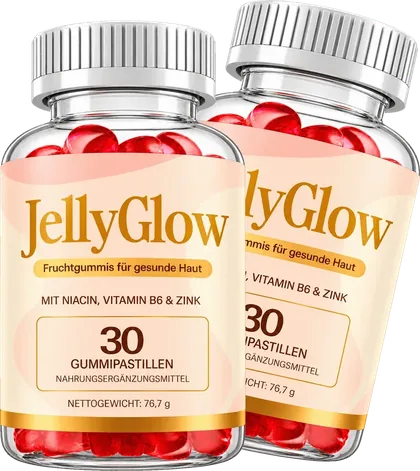
JellyGlow Gummies other ingredients are the base that turns the actives into a chewable gummy: glucose syrup, water, sugar, pectin, citric acid, natural flavours, turmeric concentrate, vegetable oil and carnauba wax1. Glucose syrup, water and sugar lead the list, so this base makes up much of each gummy.
This page goes through that base one item at a time, in the order the label lists it. It answers the questions people ask most about it: gelatin, allergens, the colour, the sugar and whether the gummy suits a plant-based diet. We are an independent information site, not the maker or seller, and we report only what the label we hold shows.
01What are the other ingredients in JellyGlow Gummies?
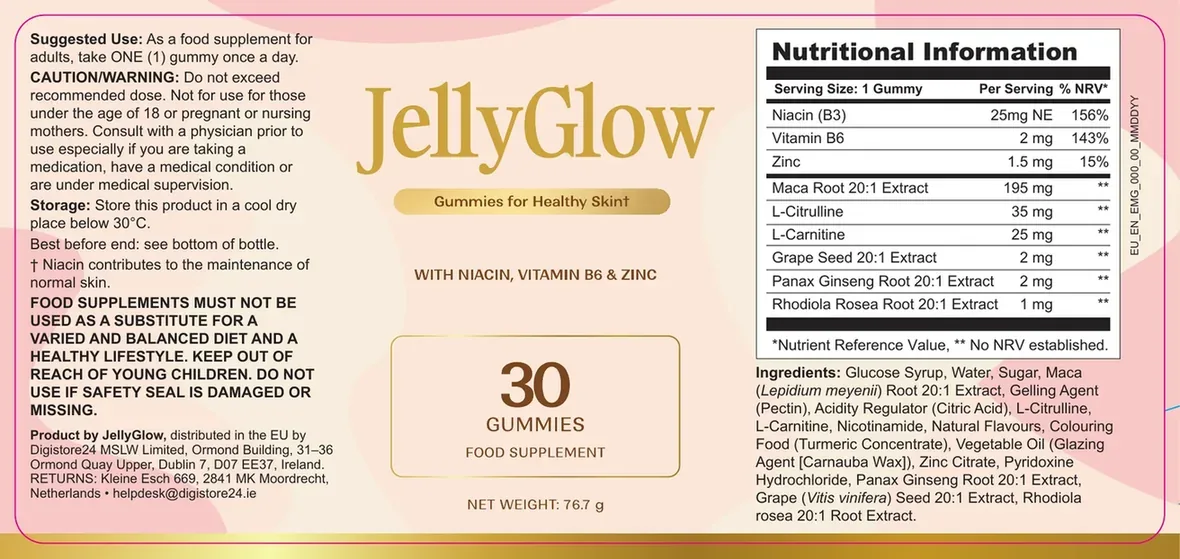
The non-active ingredients in JellyGlow Gummies are eight entries that form, flavour, colour and coat the gummy1. Here they are in the order they appear in the full ingredient list.
| Label wording | Role in the gummy | Position in the full list |
|---|---|---|
| Glucose syrup | Sweetener and body | 1st |
| Water | Base liquid | 2nd |
| Sugar | Sweetener | 3rd |
| Gelling agent (pectin) | Sets the gummy | 5th |
| Acidity regulator (citric acid) | Tartness and acidity | 6th |
| Natural flavours | Taste | 10th |
| Colouring food (turmeric concentrate) | Colour | 11th |
| Vegetable oil (glazing agent [carnauba wax]) | Surface coating | 12th |
The gaps in the numbering are the actives: maca at 4th, then L-citrulline, L-carnitine and nicotinamide, and after the glaze zinc citrate, pyridoxine hydrochloride, ginseng, grape seed and rhodiola. The main ingredients page covers those actives.
The roles in the middle column are the label's own words where it gives one, such as gelling agent and acidity regulator, and our plain description where it does not.
02Do JellyGlow Gummies contain gelatin?
No gelatin is listed on the JellyGlow label we hold. The gelling agent is pectin, which the label names in brackets after "gelling agent"1.
Many gummies use gelatin, which comes from animals, to get their chew. Pectin is a different setting agent, made from fruit. So for people who avoid gelatin for diet, faith or personal reasons, the label is a good sign.
A label can only tell you what is listed, though. It does not tell you about shared equipment or about the source of every sub-ingredient. If gelatin is a strict line for you, email the order desk at helpdesk@digistore24.ie and ask them to confirm in writing that no gelatin or animal-based setting agent is used in the gummy or its coating.
03What does pectin do in JellyGlow Gummies?
Pectin is the gelling agent in JellyGlow Gummies, the ingredient that sets the warm syrup into a firm, chewable shape1. It is the fifth item in the list, right after the maca extract.
Pectin is the same kind of setting agent used in many jams and fruit jellies. It needs sugar and acid to set well, which is one reason glucose syrup, sugar and citric acid sit near it on the list.
Pectin gummies tend to have a softer, shorter bite than gelatin gummies, and they can stick together in warm, humid places. That fits the label's storage line: keep the jar in a cool, dry place below 30°C, which is 86°F by our conversion. If gummies have melded into one lump, the jar may have been stored too warm. Check the seal and the best-before date on the base before using it.
04How much sugar comes from the JellyGlow Gummies base?
Glucose syrup is the first ingredient and sugar is the third, so the base of each JellyGlow gummy is built on added sugars1. The label we hold does not show grams of sugar or calories per gummy.
FDA guidance counts table sugar and syrups as added sugars, sets the Daily Value for added sugars at 50 g a day, and the Dietary Guidelines advise keeping added sugars under 10% of daily calories2. One small gummy is unlikely to be a large share of that, but without a figure on the label we cannot give you a number.
- If you count sugar for diabetes or any other reason, ask the order desk for the full nutrition panel with grams per gummy.
- Count the gummy with everything else you eat that day.
- Ask your doctor or diabetes educator before using it, since ginseng in the same gummy may lower blood sugar3.
Our sugar page goes into this in more depth.
05Why does JellyGlow Gummies list turmeric as a colour?
Turmeric concentrate is listed as a "colouring food," meaning it is in JellyGlow Gummies to give colour, not as an active1. It has no amount on the panel because it is not one of the actives.
"Colouring food" is EU label wording for a food ingredient used for its colour, as opposed to an additive with an E number. Turmeric concentrate gives a yellow to orange shade. It is the only colouring the ingredient list names.
The jar photos we hold show red, heart-like gummies1. We cannot tell from the label alone how that shade is reached with turmeric as the only listed colouring food, so if colour matters to you, for example because of a food sensitivity, ask the seller to confirm every colouring used. Do not read the turmeric line as a health ingredient. It is not listed in the nutrition panel, and nothing on the label makes a claim for it.
06What are the citric acid, flavours and carnauba wax in JellyGlow Gummies?
Citric acid is an acidity regulator for tartness, natural flavours give the taste, and vegetable oil with carnauba wax is a glazing agent that coats the outside1. All three are standard gummy ingredients.
Citric acid
Citric acid gives a sour, fruity edge and helps pectin set. It is the sixth ingredient.
Natural flavours
The label says "natural flavours" without naming which ones or what they come from. If you have a fruit or other food sensitivity, that is a fair thing to ask the seller about.
Vegetable oil and carnauba wax
The glaze keeps gummies from sticking to each other in the jar. Carnauba wax comes from the leaves of a palm, and the label does not name the vegetable oil it pairs with. Our nutrition facts page sets the base beside the active panel.
07How do the vitamin forms appear among JellyGlow Gummies ingredients?
The vitamins and zinc show up in the ingredient list under their chemical names, not their everyday names1. That can make them look like extra additives when they are the actives.
- Nicotinamide is the form of niacin, 25 mg NE per gummy. See our niacin page.
- Pyridoxine hydrochloride is the form of vitamin B6, 2 mg per gummy.
- Zinc citrate is the form of zinc, 1.5 mg per gummy.
None of these belongs to the gummy base. We list them here only so that a reader scanning the label for unfamiliar words knows which ones are the vitamins. Everything else on the list that is not an active is covered on this page.
08Does the JellyGlow Gummies label list any allergens?
The JellyGlow label we hold does not flag any allergens. There is no allergen statement, and no ingredient in the list is marked out as an allergen1. EU labels usually mark allergens by emphasis, such as bold type, inside the ingredient list.
An unflagged label is not the same as a promise. Several items do not name their source, so people with allergies should ask before using the gummies:
- Glucose syrup: the label does not say what plant it comes from.
- Natural flavours: not named.
- Vegetable oil: the plant is not named.
- Factory practices: no shared-equipment or may-contain statement appears, and the place of manufacture is not stated.
Email helpdesk@digistore24.ie with your specific allergy and ask for a written answer. Bring the label to your doctor or allergist as well. If you have a reaction, stop and get help, and you can report it to the FDA through MedWatch4. See our side effects page for signs to act on.
09Are JellyGlow Gummies suitable for a plant-based diet?
Possibly, but the label does not say so. No gelatin is listed, pectin sets the gummy and carnauba wax comes from a plant, yet the label makes no vegetarian or plant-based claim1.
The open points are the ones a label often leaves out. Natural flavours are unnamed, and the active L-carnitine and L-citrulline lines do not state how those compounds were made. Glucose syrup, sugar and the vegetable oil do not name their sources either.
So the careful answer is this. Nothing on the label we hold is clearly animal-derived, and no gelatin is listed. If your diet is strict, ask the seller to confirm in writing that every ingredient, including flavours and the amino-acid actives, is free of animal sources. Our L-carnitine page and who it's for page add context.
The seller’s four badges, explained


Badges supplied by the seller, in German. They are the seller's own marks, not third-party certifications; we explain what each one means.
Safety: JellyGlow is for adults 18 and over. The label says it is not for pregnant or nursing women. Its vitamins add up with other supplements, and it lists botanicals with limited safety data, including ginseng and L-citrulline, which can matter with medicines for blood sugar, blood pressure or erectile dysfunction. If you have a medical condition or take any medicine, ask your doctor or pharmacist before use. Never change a prescribed medicine on your own. Stop and get medical help for a severe rash, swelling, trouble breathing, fainting, or yellow skin or eyes.
Frequently asked questions
Is there gelatin in JellyGlow Gummies?
No gelatin is listed on the label we hold. The gelling agent is pectin , but ask the seller in writing if gelatin is a strict line for you.
Do JellyGlow Gummies have any animal-based ingredients?
Nothing on the label is clearly animal-derived and no gelatin is listed, but the label makes no plant-based claim. Ask the seller to confirm the flavours and the amino-acid actives.
What allergens are in JellyGlow Gummies?
The label we hold flags no allergens and has no may-contain line. The sources of the glucose syrup, natural flavours and vegetable oil are not named, so ask the seller about your specific allergy.
Why is turmeric on the JellyGlow Gummies label?
Turmeric concentrate is listed as a colouring food, so it is there for colour, not as an active. It has no amount on the panel and no claim attached.
What does the pectin in JellyGlow Gummies do?
Pectin is the gelling agent that sets the gummy into its chewable shape. It replaces gelatin, which is not listed.